
After decades of designing homes across York Region and the GTA, we’ve had a version of the same conversation hundreds of times. A client arrives with a clear vision, a folder full of inspiration images, and a number in mind. Our job isn’t to say no to any of it. It’s to figure out what’s really driving that vision and help them get there in a way that actually works for their specific home, their lifestyle, and their budget.

These are the gaps we see most often.

Open Concept Sounds Great Until You Lose Your Walls

Open concept is one of the most requested changes we hear. More flow. More light. A connected space for the family. And in the right home, it absolutely delivers on all of that.

But walls do a lot of work that doesn’t get talked about enough. They’re where your feature moment lives. Your art. Your built-ins. Your fireplace surround. The wall that anchors your dining room or creates a defined entry into your living space. When you remove them, you often end up with one large, undefined room that is actually harder to furnish, harder to make feel warm, and harder to give a sense of purpose.

There’s also the acoustic and practical reality. Sound travels. Cooking smells travel. What feels like a seamlessly connected family home in the imagination can start to feel like one continuous noise zone in real life, especially with kids, guests, or a television going in multiple directions.

What we usually recommend instead: defined zones that still feel connected and open to each other. You get the flow. You keep the intimacy of each space. You protect the walls that are doing real design work. It’s actually a harder problem to solve than simply opening everything up, and the result is almost always more livable and more beautiful.

More Furniture Does Not Mean a Better Room

This one surprises people, but it’s one of the most consistent things we see.

Clients want a room that feels full, layered, and considered. So the instinct is to add. Another chair. A console. An extra side table. A second sofa. And slowly, the space starts to feel crowded rather than curated.

Great design actually relies on restraint. The negative space in a room, the breathing room between pieces, is what allows the furniture you do have to be seen and appreciated. When a room is overfilled, nothing reads clearly. The eye doesn’t know where to land. Traffic flow gets disrupted. The space feels smaller, not larger, even if the square footage is generous.

The pieces you choose matter far more than the number of pieces you have. Fewer, better selections that are properly scaled to the room will always outperform a room packed with things that individually might be beautiful but collectively compete with each other.

Part of our job is to tell you what to take out as much as what to bring in. That edit is where a room often comes to life.


The Right TV Is the One That Fits the Room

Every client wants to go bigger. We completely understand the impulse. Screens have become the centrepiece of how we relax, entertain, and spend time at home, and the experience of watching on a beautiful large screen is genuinely better. To a point.

There is a math to it that matters. Your viewing distance from the screen is what determines the right size. Too large and the picture does not resolve the way it should from where you are actually sitting. Your eyes work harder, not less. The experience degrades rather than improves.

Then there is proportion. If your television is dramatically wider than your fireplace, the entire wall loses its balance. The fireplace, which is typically the architectural anchor of the room, disappears. The TV becomes the only thing reading on that wall, whether it is on or off. The room stops feeling like a living space and starts feeling like a screening room, even if that was never the intention.

A dedicated media room where the screen is the deliberate feature? We will design the entire space around that intention and it can be stunning. But in a living room where you also want warmth, balance, art, and a space that feels beautiful when nothing is playing? Scale matters enormously.

The right television for your room is the one that works with everything else in it rather than competing with it.

That Inspiration Image Has More in It Than You Think

This is probably the conversation we have most often, and it is one of the most valuable ones we have with clients.

Someone brings in a photo of a room that looks incredible. Layered. Finished. Warm. Everything is working together and the space feels like it belongs in a magazine, because it often does. They want that feeling in their home. So do we.

But when you look closely at what is actually in those images, there is a great deal creating that feeling that is not immediately obvious at first glance. There is almost always wallpaper or a custom wall texture or limewash or a plaster finish. There are drapery panels that run floor to ceiling, almost certainly custom made and installed with intentional fullness. There are multiple light sources working together: an overhead fixture, recessed lighting on a dimmer, task lighting, a lamp or two, possibly a statement pendant. There are layered textiles, multiple materials mixing hard and soft, and accessories that were carefully selected and styled for the photograph.

Every single one of those elements is a separate budget line item. And together, they are what create the feeling that the client fell in love with.

Our job is to identify what is actually doing the heavy lifting in that image and then help you prioritize where your investment should go to get as close as possible to that result within your budget. Sometimes it is the drapery that transforms a room more than anything else. Sometimes it is the lighting layers. Sometimes it is one strong material choice on the walls. We work through that together based on your specific space and what matters most to you.

The goal is never to manage your vision down. It is to make sure your investment lands in the places that will actually give you that feeling you are after.

Trends Are Exciting. Timeless Is Better.

Social media has significantly accelerated the trend cycle in interior design. Clients come in drawn to something because they have seen it everywhere: a specific tile pattern, a paint colour, a material finish, an entire aesthetic that is having a major cultural moment right now.

And in isolation, it is often genuinely beautiful. We are not dismissing it.

But we always ask: will this still feel right in your home in ten years? Because at the level of investment that a properly designed space represents, it needs to. Replacing flooring or cabinetry or a custom built-in because it started to feel dated is an expensive and disruptive process that most clients would rather avoid.

That does not mean we play it safe. We make bold, unexpected choices regularly. Distinctive spaces are more interesting than safe ones. But we make sure the bones of the space are built on decisions that will age well, and that the personality and character come through in elements that are easier to evolve over time as your taste shifts. The sofa, the rug, the art, the accessories: those can move with you. The architecture of the space should hold.

The Budget Conversation Is the Most Important One We Have

Everything above connects back to this one.

Clients arrive with a vision and a number they have arrived at without a clear reference point for what things actually cost at this level, and that is completely understandable. How would you know if you have never done this before?

That is exactly why we talk about investment early and honestly. The worst outcome in any design project is falling in love with a result and then discovering it does not match what you were prepared to spend. We would rather have that conversation at the beginning, align on what is realistic, and build a plan that works for your home and your budget, than design something beautiful that cannot be executed.

Sometimes that means phasing a project. We tackle the spaces that matter most first and plan the rest with intention so that what gets done now does not need to be undone later when the next phase begins. Good design does not have to happen all at once. It just has to be thought through from the start.

This Is What We’re Here For

If any of this resonates, you are probably closer to ready than you think.

The clients who get the most out of working with us are the ones who arrive with a vision, are open to the conversation about what will actually work, and trust that our job is to get them to the best version of what they imagined, not a compromise of it.

We work with homeowners across York Region and the GTA from our design studio and 10,000 sq ft designer showroom in Newmarket/East Gwillimbury. If you are thinking about a project, we would love to talk.

Book a Discovery Call or Visit the Showroom

The Truth About AI and Interior Design

AI interior design tools are everywhere right now. You can upload a photo of your room, type in a few prompts, and instantly see your space transformed into something completely different. Modern organic, Parisian apartment, quiet luxury. Whatever style you’re curious about, AI can generate it in seconds.

And honestly, we get the appeal.

As interior designers, we actually think AI can be a really useful tool. It helps people visualize possibilities, narrow down styles they’re drawn to, and communicate ideas more clearly. For a lot of homeowners, it also makes the design process feel less intimidating because they can finally start to “see” what’s possible in their home.

In fact, one of the best uses for AI is helping people come into the design process with a clearer visual direction. Sometimes clients know how they want their home to feel but struggle to explain it. AI can help bridge that gap.

AI interior design tools are becoming more advanced every day, and we think they’ll continue to play a role in helping homeowners visualize ideas.

But after seeing more and more AI-generated interiors and having clients bring them to us as inspiration, we’ve also noticed where things can start to fall apart between the image and reality.

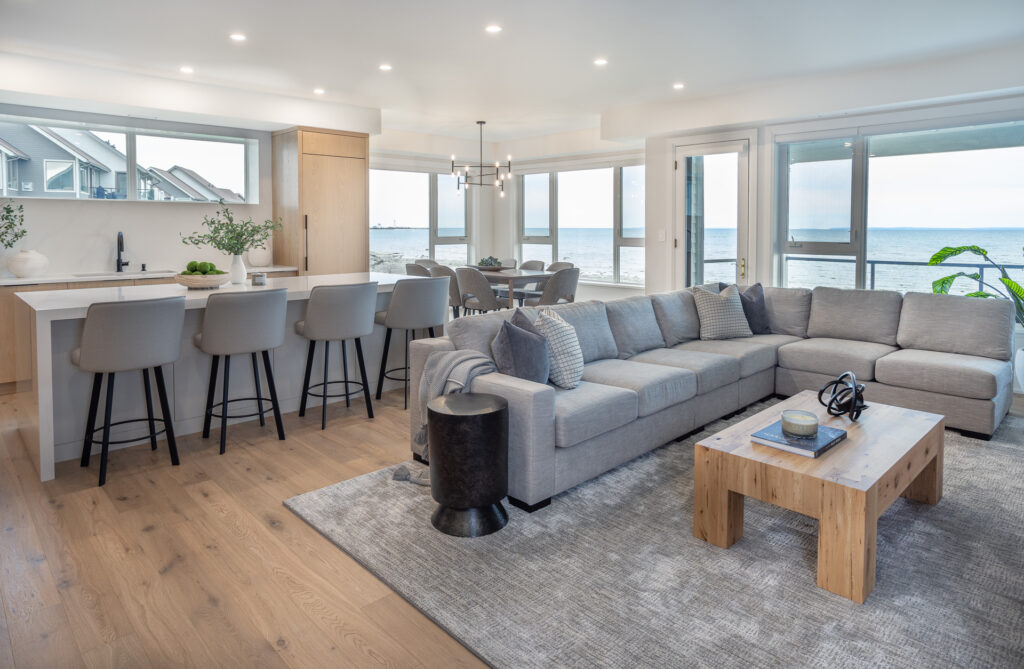
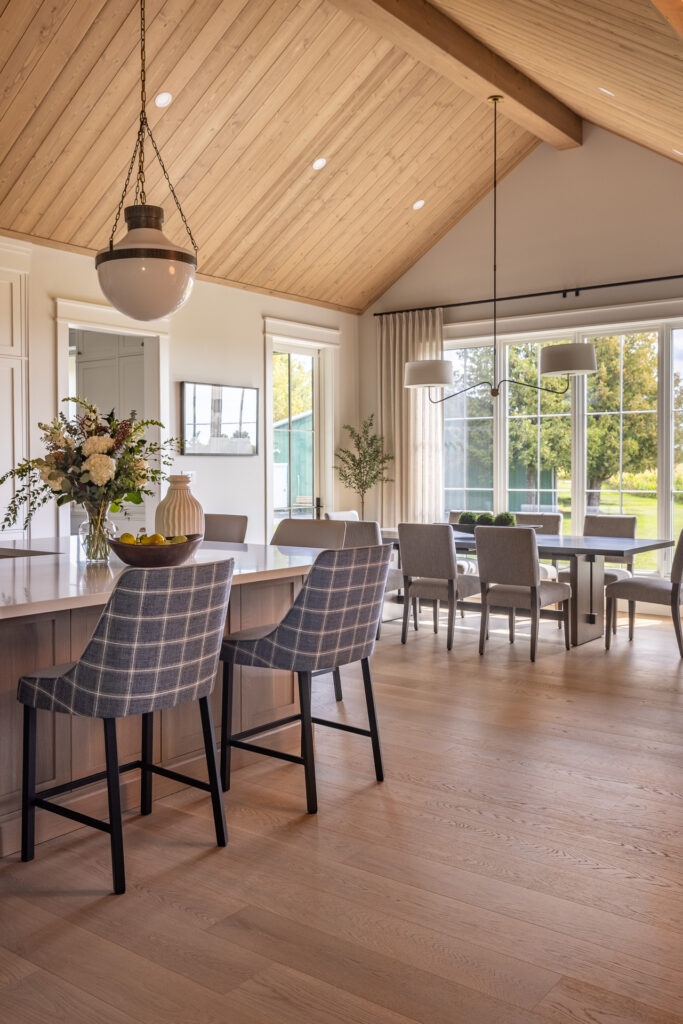
One of the biggest issues we see is scale and functionality. While AI tools are improving quickly, many of the fast visualization platforms people are using online still struggle with real-world spatial planning. A room might look beautiful at first glance, but when you really study it, things often don’t make sense. We’ve seen sofas overlapping fireplaces, dining tables with no room to walk around them, cabinetry doors that physically couldn’t open, and layouts that interrupt the natural flow of the space.

That’s because AI is focused on generating an image, not necessarily designing a room people have to live in every day.
Another thing people don’t always realize is that while AI can absolutely be prompted with lifestyle details, most homeowners don’t actually know all the right questions to ask themselves yet. That’s a huge part of what designers do during the initial planning process.

At every consultation, we ask questions clients would never think to type into an AI prompt. How do you actually use this space? Do you host often? Do your kids do homework at the island? Are you someone who lounges or prefers more structured seating? Do you need hidden storage? What’s frustrating you most about the current layout?

Those answers completely shape the design direction.

We’re also thinking beyond just the one room being updated. We’re looking at how the new space connects to the rest of the home, how the architecture flows, what existing elements should be carried through, and how to make the update feel cohesive while still giving clients the refresh they’re looking for.

That becomes especially important in the variety of homes we work on throughout York Region and the GTA, from large expansive properties to smaller downtown Toronto homes with unique floor plans, architectural quirks, and existing design details that need to be thoughtfully worked with rather than ignored.

That human understanding is hard to replicate from a photo alone.

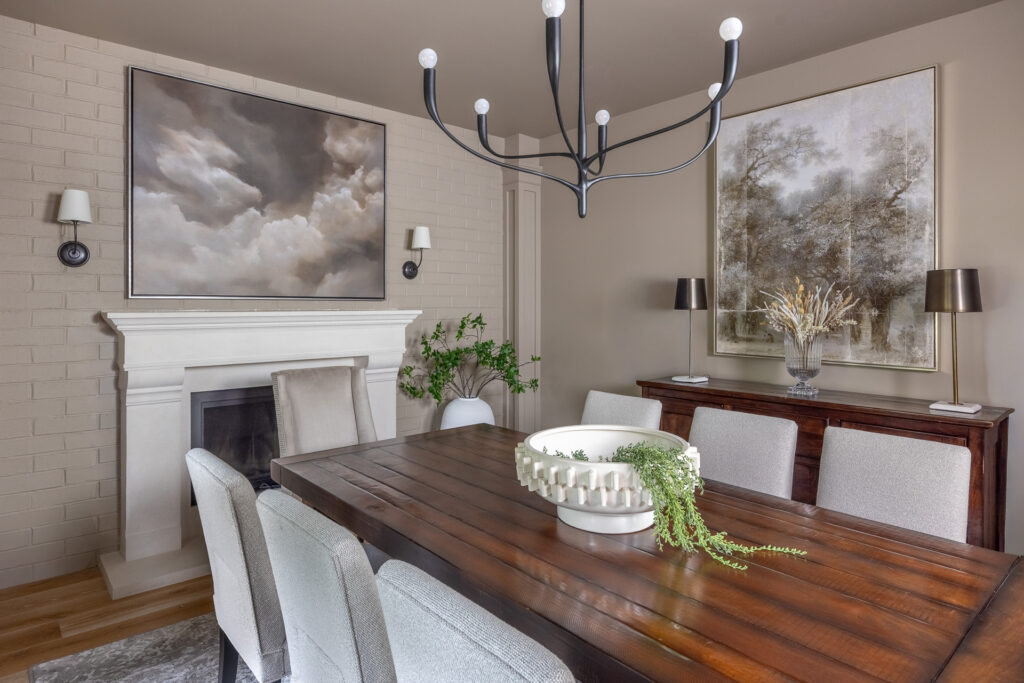
Budget is another area where AI can sometimes create unrealistic expectations. AI-generated interiors often include custom millwork, luxury finishes, oversized windows, designer lighting, and high-end furnishings without any understanding of what those choices actually cost in real life. It’s easy to fall in love with an image that may be far outside the intended renovation budget.

Part of our role as designers is helping clients understand where to invest, where to simplify, and how to create the biggest impact without losing the overall vision.
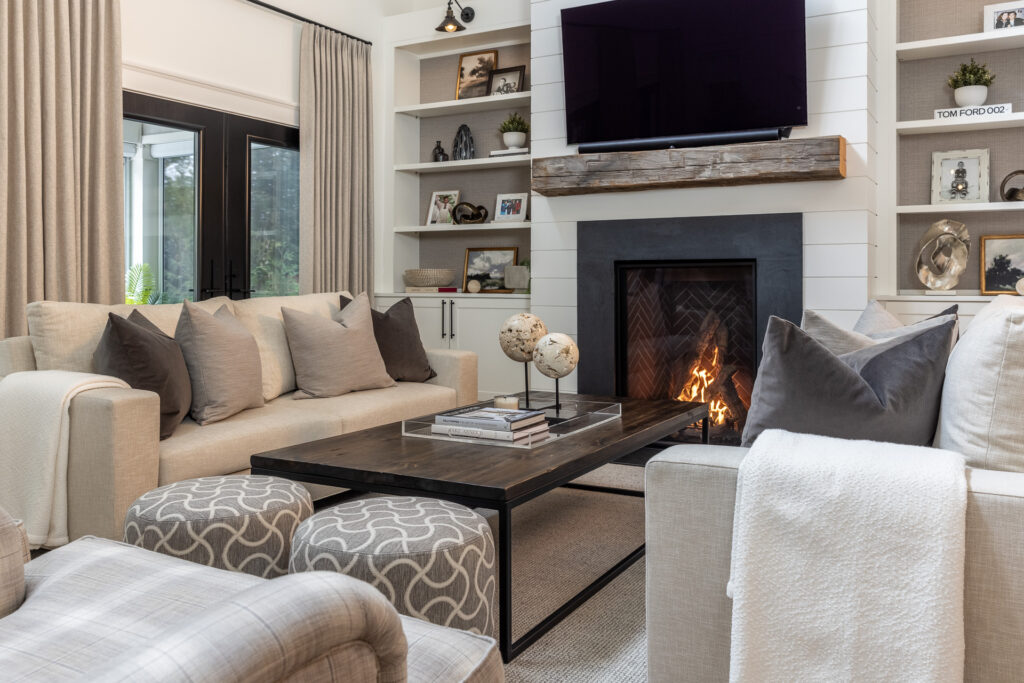
 

And finally, AI tends to design for the image itself. Real homes need more than that. They need comfort, function, durability, storage, personality, and flexibility. A chair can look sculptural and beautiful online and still be the most uncomfortable seat in your house. A home isn’t just one perfect angle on a screen. It has to support the people living in it every single day.

To be clear, we don’t think AI is replacing interior designers anytime soon, and we don’t think it’s something to fear either. We actually think it’s an exciting tool and one that will continue getting better very quickly. It can be incredibly helpful for inspiration, visualization, and even helping homeowners communicate ideas more clearly.

But there’s still a big difference between creating a beautiful image and creating a home that truly works for someone’s lifestyle. That’s really where the human side of design still matters most.

As Amanda said during our Niche Talks conversation, “AI can create beautiful inspiration images. Designers turn those ideas into livable homes.”

And honestly, that’s probably the best way to describe it. Because great design isn’t just about creating something beautiful. It’s about creating a home that works beautifully for the people living in it.

If you’re curious about how we approach the design process at Niche Decor, you can learn more about our design services here.

You can also explore some of our recent projects and see how we bring those ideas to life in real homes here.


Watch the Full Niche Talks Episode

In our latest Niche Talks conversation, Amanda and I talk about the rise of AI in interior design, where we think it’s incredibly useful, and the things homeowners should still keep in mind when using it to envision their space.

Watch the episode below:

Can AI Actually Replace Interior Designers? What AI Gets Wrong About Real Homes | Niche Decor